You called me. No — you called ME. Before US-China meeting, nations each say the other wanted talks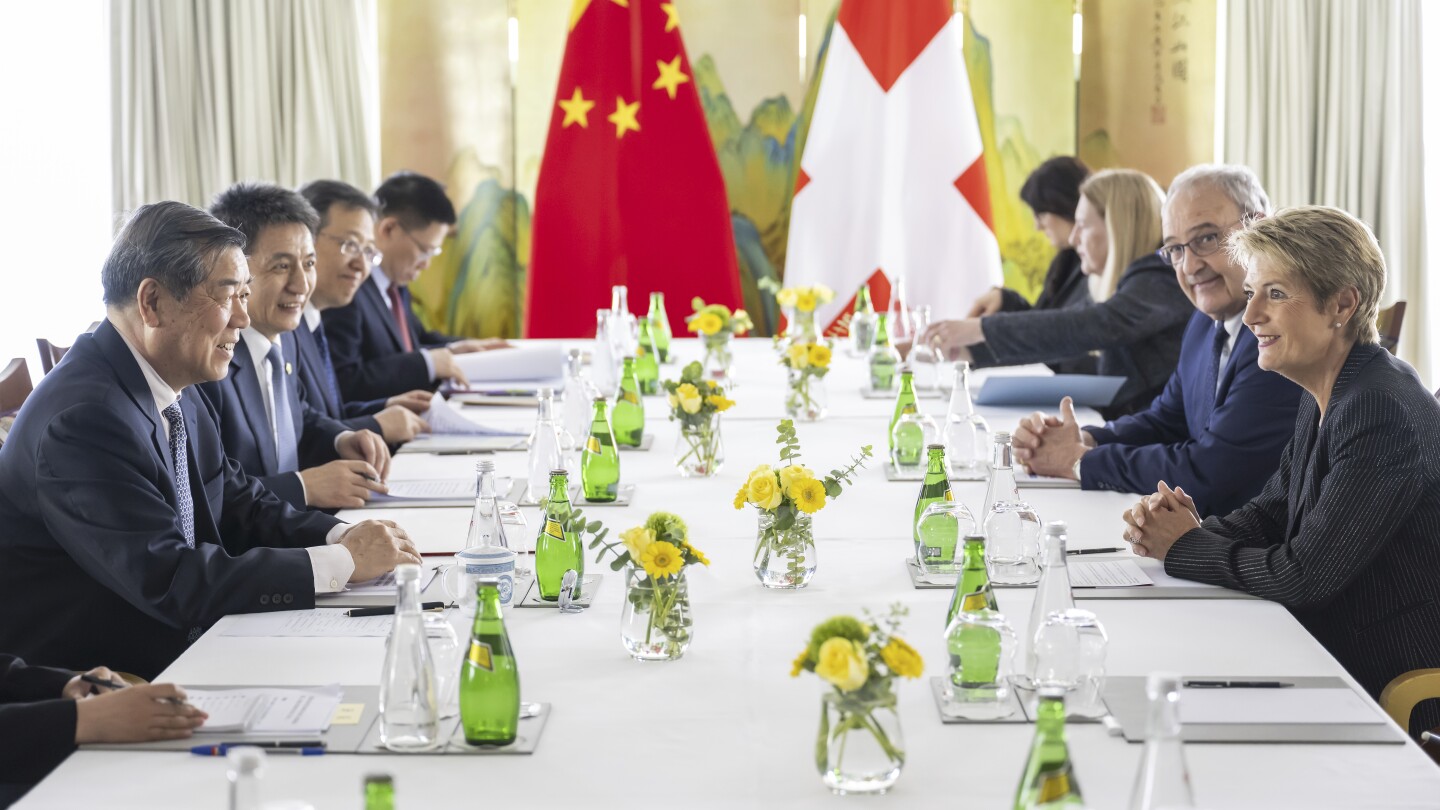 Chinese Vice Premier He Lifeng, left, Switzerland's Economy Minister Federal Councillor Guy Parmelin, center, Switzerland's President Karin Keller-Sutter, right, speak, during a bilateral meeting between Switzerland and China, in Geneva, Switzerland, on Friday, May 9, 2025. (Martial Trezzini/Keystone via AP, Pool)
2025-05-09T17:55:53Z
WASHINGTON (AP) — Who called first?
It’s the question that has put Beijing and Washington in a verbal sparring match even as the two countries are heading into a weekend meeting in Switzerland to data-gtm-enhancement-style="LinkEnhancementA" href="https://apnews.com/article/trump-china-trade-switzerland-bessent-2a3335ed92989dc4b3a74ea550b79b3f">discuss lowering sky-high tariffs that they data-gtm-enhancement-style="LinkEnhancementA" href="https://apnews.com/article/china-us-trump-tariffs-2e05057e973e1e26d1b95c5be003b4cd">slapped on each other in heated moments that have shaken financial markets and stirred worries about the global economy.
“The meeting is being held at the request of the U.S. side,’’ Chinese Foreign Ministry spokesperson Lin Jian said Wednesday.
President Donald Trump disagreed. “They said we initiated it? Well, I think they ought to go back and study their files,” Trump said Wednesday when swearing in David Perdue as the new U.S. ambassador to China. That followed weeks of each side suggesting the other side had reached out first, including Trump implying Chinese President Xi Jinping had called him, only to be refuted by Beijing.
When it comes to the world’s two largest economies readying themselves for what is expected to be tough trade talks, the public back-and-forth is no trivial matter.
“The obsession with who reached out first is a proxy fight over leverage,” said Craig Singleton, senior director of the China program at the Washington-based think tank Foundation for Defense of Democracies. “For Washington, signaling that Beijing initiated the meeting reinforces the narrative that the tariffs are working. For Beijing, denying outreach preserves the illusion of parity and avoids domestic perception of weakness.”
Jockeying for dominance
Daniel Russel, a former U.S. diplomat who oversaw East Asian and Pacific affairs, called the exchange “part diplomatic stalemate and part dominance display worthy of a nature documentary.”
In his decades-long career as a diplomat, Russel said he is unaware of a single instance where a Chinese leader initiated a call with a U.S. president. “It may be pride, it may be protocol, but for Beijing, being the demandeur is to show weakness — and that’s something the Chinese system is hardwired to avoid,” said Russel, now vice president for international security and diplomacy at the Asia Society Policy Institute.
The Trump’s administration is less accommodating. “Their position is: ‘If Xi wants the tariffs lifted, he knows how to reach us,’” Russel said.
Not long after Trump raised tariffs on Chinese goods to 145% and Beijing retaliated with 125% tariffs on U.S. goods, Trump suggested that China, like many other countries, was in talks with his administration. On April 22, he data-gtm-enhancement-style="LinkEnhancementA" href="https://apnews.com/live/donald-trump-news-updates-4-22-2025#00000196-5e9a-d2eb-abdf-5efa737e0000">apparently directed White House Press Secretary Karoline Leavitt to say “we’re doing very well” regarding a potential trade deal with China.
“I think it’s a process that’s going to go pretty quickly with China,” data-gtm-enhancement-style="LinkEnhancementA" href="https://apnews.com/live/donald-trump-news-updates-4-22-2025#00000196-5fbf-d328-a7b6-5fffd4640000">Trump said on the same day. “I think we’re going to live together very happily and ideally work together.”
Back and forth ... and back again
Yet China quickly data-gtm-enhancement-style="LinkEnhancementA" href="https://apnews.com/article/china-us-tariff-negotiations-trump-481ff4402f5c34776ffcb8ced4c8ae42">denied any talk towards a deal. When asked about such negotiations, Chinese foreign ministry spokesman Guo Jiakun responded: “All is fake news.” The next day, Guo asked the U.S. to data-gtm-enhancement-style="LinkEnhancementA" href="https://www.fmprc.gov.cn/eng/xw/fyrbt/lxjzh/202504/t20250425_11604503.html" target="_blank" rel="noopener">“stop creating confusion” on tariff talks.
Then came a data-gtm-enhancement-style="LinkEnhancementA" href="https://apnews.com/live/donald-trump-news-updates-4-25-2025#00000196-6d10-d26b-a3f7-6dd54f390000">TIME magazine interview when Trump claimed Xi had called him. Details? None provided. When? Trump didn’t say. “He’s called. And I don’t think that’s a sign of weakness on his behalf,” Trump said in the interview published on April 25. data-gtm-enhancement-style="LinkEnhancementA" href="https://www.fmprc.gov.cn/eng/xw/fyrbt/lxjzh/202504/t20250428_11606273.html" target="_blank" rel="noopener">Beijing dismissed it, saying there was no recent leadership phone call.
Yet soon the word started to spread on China’s social media that the Trump administration was contacting Beijing, and data-gtm-enhancement-style="LinkEnhancementA" href="https://apnews.com/article/china-tariffs-trump-trade-8637f1b88cf6801c9b9d2b3481389bee">it was confirmed a few days later by the Chinese Commerce Ministry.
The U.S. had “repeatedly” and “proactively” conveyed messages to China recently to express the hope to engage in negotiations with China, the ministry said on May 2. “In this regard, the Chinese side is assessing it,” the ministry said, in an apparent off-ramp move climbdown that prepared the public opinion for the announcement a few days later that Vice Premier He Lifeng would meet U.S. Treasury Secretary Scott Bessent in Switzerland this weekend.
Sun Yun, director of the China program at the Stimson Center, said the reality is more complicated when the two governments have been in regular contact and each side may have its own understanding what constitutes “reaching out” for tariff talks. “Technically,” Sun said, “both sides are correct.”
By Thursday, Trump appeared ready to move on. “We can all play games — who made the first call, who didn’t make them. Doesn’t matter,” Trump said.
Referring to the upcoming tariff talk this weekend in Switzerland, Trump said: “It only matters what happens in that room.”
 >
>
DIDI TANG Tang joined the AP Washington bureau in 2023 after spending 11 years in Beijing as a China correspondent. She covers anything related to the Indo-Pacific region with a focus on U.S.-China competitions
mailto
Source:
You called me. No — you called ME. Before US-China meeting, nations each say the other wanted talks


 Topic: You called me. No — you called ME. Before US-China meeting, nations each say the other wanted talks (Read 2407 times)
 Similar topics (5)

 October 29, 2014, 08:45:24 AM